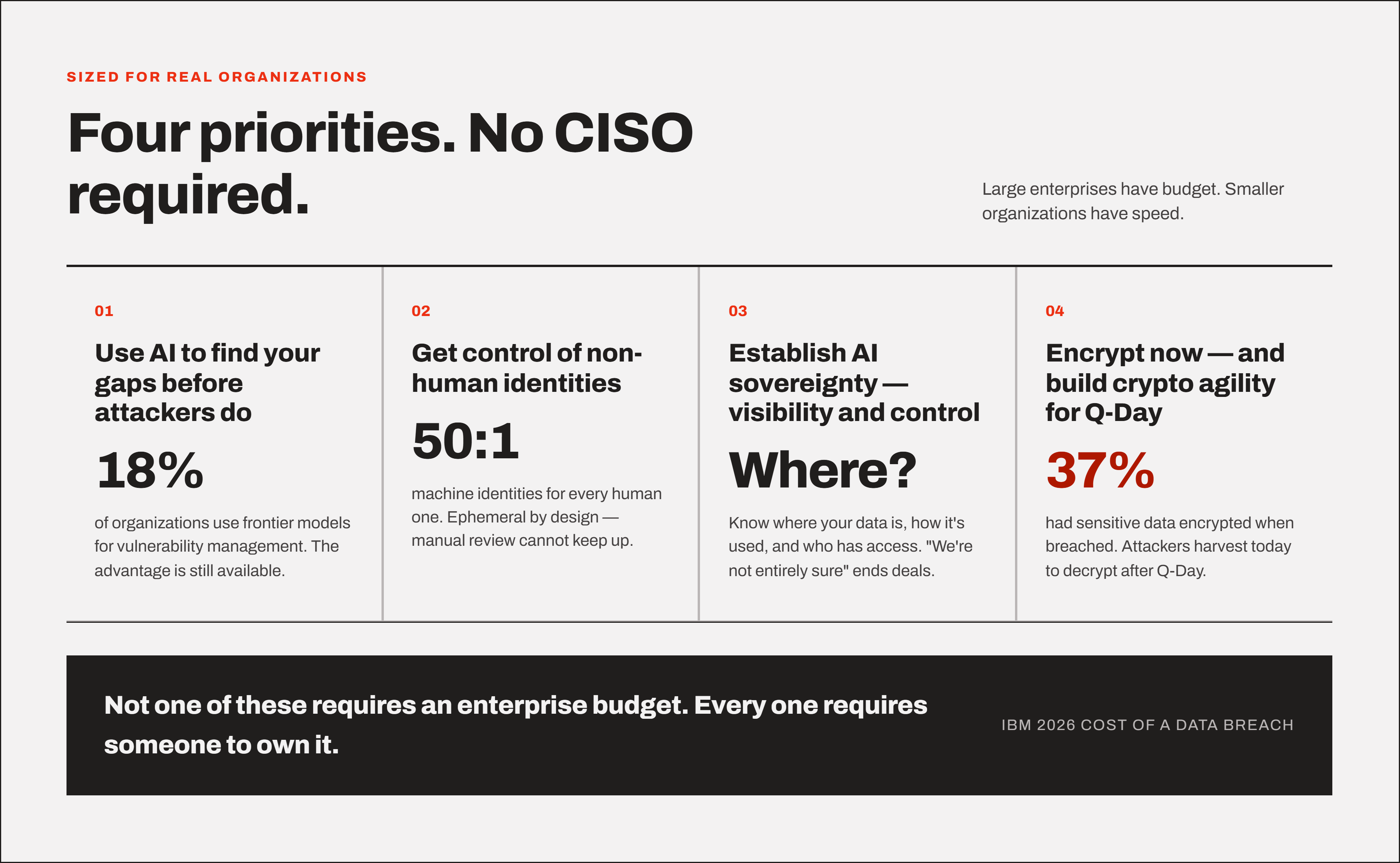

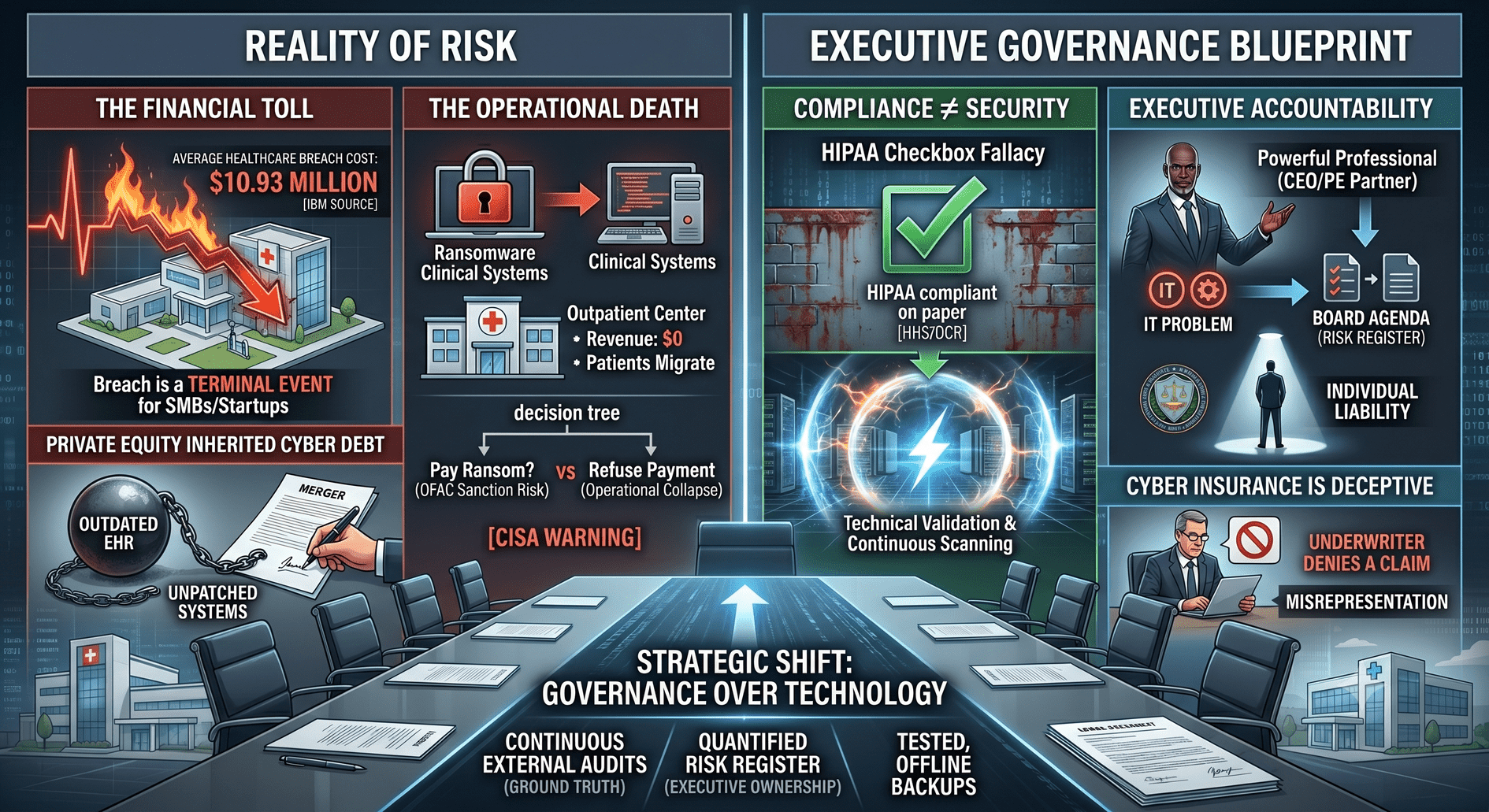
A single data breach in the United States now costs an average of $11.5 million. In healthcare specifically the average is $6.64 million, which has been the highest of any sector for thirteen consecutive years (IBM Cost of a Data Breach Report 2026, research conducted independently by the Ponemon Institute). Private equity firms buy these liabilities every day. They do not know it until federal regulators begin an audit. For an SMB healthcare practice or a digital health startup, a breach is not an inconvenience. It is a terminal event. Most executives view security as an isolated IT expense. They treat compliance as an annual paperwork exercise. This misunderstanding creates immediate, catastrophic financial vulnerability.
Two honest caveats, because you deserve the whole picture rather than the frightening half of it. Healthcare's average has fallen for three consecutive years, down 10.5% in the last one alone. That is real and it is good news. It is also one favorable stretch in a fourteen-year series, set against a US all-industry average that rose to a record high and global costs that climbed 12%.
The cost structure of a healthcare security failure is unforgiving. It is front-loaded with forensic investigators, class-action defense attorneys, and mandatory notification logistics. Long-term reputational damage drains patient volume. Settling a patient privacy suit can wipe out multiple years of EBITDA.
Founders frequently believe their small size protects them. They assume hackers target only massive health systems. This logic is completely flawed. Automated scanning tools do not care about your revenue lines. They look for unpatched vulnerabilities and exposed cloud databases. Unsecured systems are a statistical certainty for exploitation.
Security is a business-risk issue. It belongs on the board agenda next to capital allocation and revenue growth. When a breach occurs, the loss of trust is immediate. Patients expect privacy. Partners demand data integrity. If you cannot provide both, your market value disappears.
Compliance is not security. This is the hardest truth for healthcare executives to accept. A business can be fully compliant with the Health Insurance Portability and Accountability Act (HIPAA) on paper while remaining completely vulnerable to a ransomware attack. The HHS Office for Civil Rights enforces the law, but their regulations establish a bare minimum floor, not an operational ceiling.
Many organizations rely on automated compliance software. These platforms promise compliance in 30 days. They generate templates for policies and procedures. Employees click through a ten-minute video training module. Executive leadership signs off, checking the box. This creates a false sense of safety. Template policies do nothing to stop a phishing email from compromising an administrator's credentials. They do not ensure multi-factor authentication is enforced on every external access point.
Look at actual enforcement actions. The U.S. Department of Health and Human Services routinely penalizes organizations that possessed written policies but failed to implement them. The systemic failure is always governance. A policy that sits in a digital drawer is useless during an investigation. When a breach occurs, investigators demand proof of continuous operation. They look for evidence of regular risk analyses, system log reviews, and active vulnerability management.
If your security posture exists only as a static document, the federal government treats it as non-existent. The fines reflect that negligence. Security requires continuous technical validation. It requires scanning your perimeter for weaknesses weekly, not yearly. It requires testing your employees with simulated phishing attacks to measure their actual awareness. If you cannot measure your security posture with technical data, you do not have a security posture. You have a stack of papers that will not protect you in court.
Private equity firms are aggressively consolidating the healthcare marketplace. They acquire dermatology practices, physical therapy clinics, and behavioral health platforms. Yet, their traditional due diligence process is fundamentally broken. It focuses heavily on coding compliance, utilization reviews, and financial metrics. Cyber due diligence is often reduced to a brief questionnaire. This oversight alters the economics of the acquisition entirely.
When a private equity firm buys an SMB healthcare provider, it inherits its historical technical debt. If the target company has ignored software updates for five years, that risk transfers to the buyer. If the practice lacks proper network segmentation, the entire portfolio faces exposure. Security failures post-acquisition directly degrade asset value. A ransomware attack three months after closing halts cash flow. It destroys the investment thesis.
Consider the operational impact of a security overhaul. Fixing a broken IT environment requires unbudgeted capital expenditures for replacing legacy hardware, retraining staff, and deploying modern tools. If the private equity firm fails to uncover these gaps during the diligence phase, they pay for them later at a premium. The valuation paid for the asset becomes artificially inflated.
True diligence requires a technical assessment of the actual infrastructure. It demands a review of the target's past security incidents, configuration status, and current defense maturity. Private equity partners must realize that a clinic with weak cyber defenses is an unfunded liability. The purchase price must reflect the cost of bringing that asset up to a secure operational standard.
The financial impact of a federal fine is predictable. The operational impact of a total system shutdown is chaotic. Ransomware does not simply steal data; it stops the delivery of medical care. When clinical systems go dark, doctors cannot access patient charts. Labs cannot process blood work. Imaging centers cannot view scans. The practice stops functioning entirely.
The Cybersecurity and Infrastructure Security Agency frequently warns that healthcare infrastructure remains a primary target for sophisticated extortion groups. These attackers know that operational downtime in medicine costs lives. They use this knowledge to demand exorbitant payouts. If an outpatient surgical center cannot operate for two weeks, the revenue loss is permanent. Patients migrate to competitors immediately. They do not return.
The decision to pay a ransom presents an exceptional legal risk. The U.S. Department of the Treasury Office of Foreign Assets Control enforces strict rules against making payments to sanctioned entities. If an organization pays a ransom to a threat group associated with a banned nation-state, they face severe federal prosecution. This puts executives in an impossible position. Pay the ransom and risk federal sanctions, or refuse the payment and watch the business collapse.
The only escape from this trap is prevention and resilient backup architectures. Businesses must maintain offline, immutable backups that ransomware cannot encrypt. These backups must be tested regularly to ensure rapid recovery.
Many boards believe cyber insurance solves the entire security problem. They view policies as a financial safety net that catches any fall. This is an expensive illusion. The cyber insurance market has tightened dramatically over recent years. Underwriters no longer issue comprehensive policies based on vague promises. They demand verified proof of specific security controls.
If an executive signs an insurance application claiming the organization enforces multi-factor authentication across all systems, but a single legacy server was excluded, the policy is compromised. When that legacy server becomes the entry point for an attack, the insurer will deny the claim. They will cite misrepresentation on the application. The business is left to fund the entire recovery internally.
Insurance also fails to cover the full spectrum of operational loss. It may pay for data recovery and legal fees. It will not pay for the lost lifetime value of patients who leave the practice permanently. It will not repair a shattered corporate reputation in the market. Relying on insurance as a primary security strategy is a failure of leadership.
Technology alone cannot solve a cultural problem. Buying expensive firewalls and software agents provides a false sense of security if leadership ignores governance. Security is an ongoing operational discipline. It requires executive oversight, continuous budget allocation, and clear accountability.
Boards must demand regular, independent security assessments. These reviews should not be performed by the internal IT team or the current managed service provider. An external, objective audit provides the ground truth. It identifies where the actual gaps lie.
Leadership must also establish a formal risk register. Every identified security vulnerability must be logged, quantified, and assigned an owner. The board must decide whether to fund the remediation, accept the risk, or transfer it. This formal process transforms security from an abstract technical issue into a standard business operational metric. It forces executive-level ownership.
The regulatory environment is shifting toward individual executive accountability. Regulators are no longer satisfied with corporate fines that are absorbed as a business cost. They are looking at the individuals who signed off on inadequate security programs. This trend will only accelerate.
As a founder, CEO, or private equity partner, the responsibility stops with you. You cannot delegate this accountability to an outsourced IT vendor or a mid-level manager. If your organization processes, stores, or transmits protected health information, you are in the risk management business. Your security posture reflects your operational maturity.
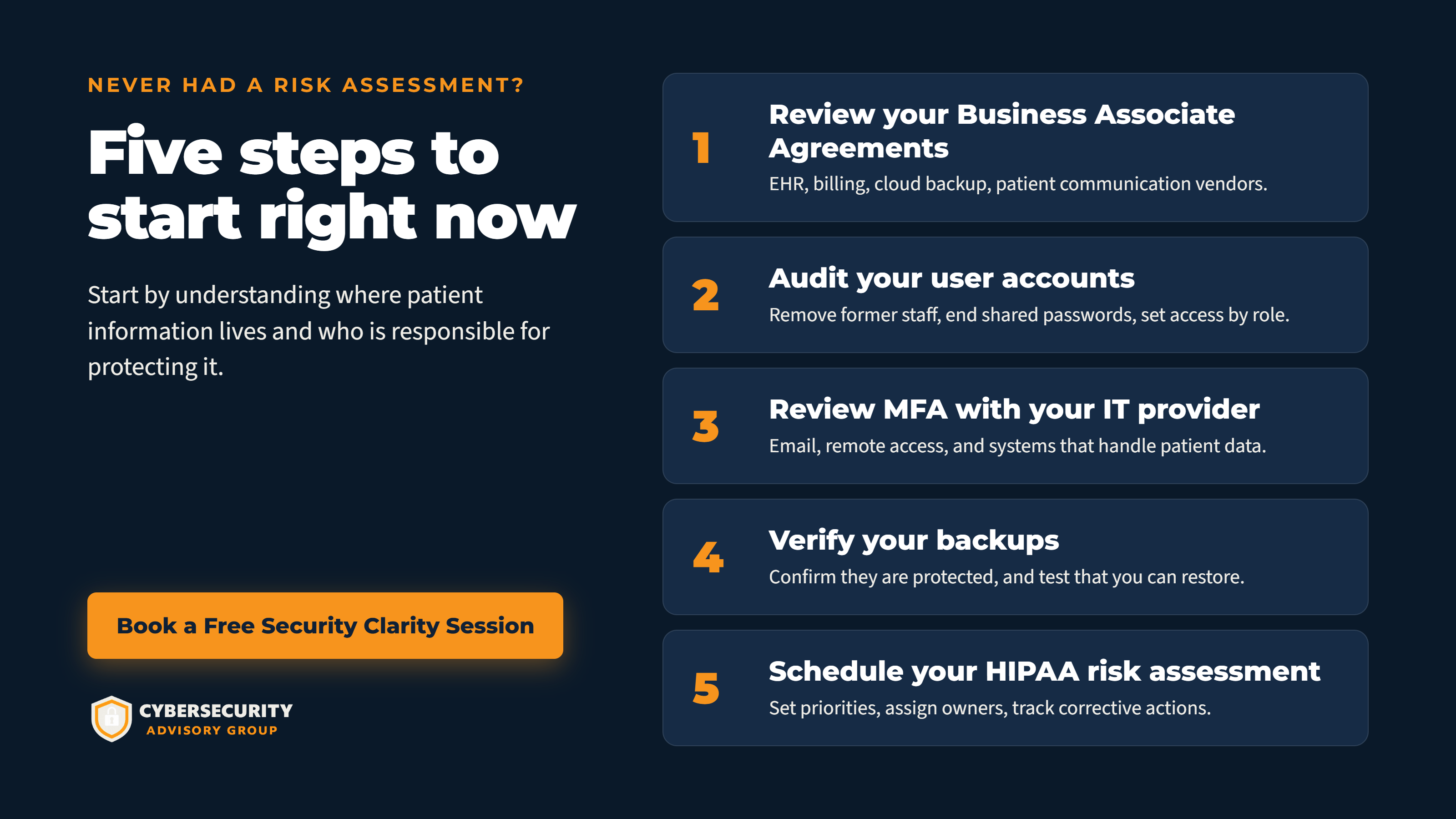
Stop treating cybersecurity as an IT problem. Audit your current vendors. Validate your backup capabilities. Challenge your internal teams to prove their compliance claims with real-world technical data. The survival of your practice, your startup, or your portfolio company depends on the actions you take before the attack occurs. Implement real governance today, or prepare to manage a crisis tomorrow.
Book Your Free Security Clarity Session Today and take the first step toward protecting your patients, your agency, and your peace of mind.
Connect with Melissa Thornton on LinkedIn
Updated September 2026 with current IBM Cost of a Data Breach figures and to remove an unverified claim about regulatory precedent.