
The 2026 IBM Cost of a Data Breach report puts the average U.S. breach at $11.5 million. Globally, the average sits around $5 million per incident — up 12% from last year, which is considerably more than inflation accounts for.
If you run a 40-person managed services company, a three-location dental group, or a Series A digital health startup, there is a reflexive reaction to numbers like that: those are enterprise numbers. That is not my world.
That reaction is the vulnerability.
Because buried in the same report is a figure that scales to any organization, regardless of headcount or revenue: every hour a breach remains active costs roughly $1,100. That is not a headline. It is a clock. And it runs at exactly the same speed inside a 25-person practice as it does inside a Fortune 500.
The real message of this year's report is not the size of the loss. It is the duration of the exposure — and duration is precisely where smaller organizations are structurally worse off.
There is no shortage of alarming security statistics in circulation, most of them produced by vendors with something to sell. This one is built differently, and it is worth understanding why before we act on it.
IBM contracts the Ponemon Institute — a separate, independent organization — to conduct the research, and has done so for 21 consecutive years. That longitudinal depth means trends can actually be distinguished from noise.
The methodology also works against exaggeration rather than toward it. Statistical outliers at both extremes are removed from the dataset, so a single catastrophic mega-breach cannot drag the average upward and overstate the typical experience.
This year's edition drew on 602 organizations that suffered a breach in the study period, with 3,558 interviews — security teams, C-suite, and business leaders, all with firsthand knowledge of what happened. The sample spans 17 industries across 16 countries.
Here is the detail most relevant to you. The breaches studied ranged from 2,590 records to 115,380 records.
Read that range again. A 2,590-record breach can represent the entire patient panel of a small specialty practice. It is the full customer list of a seed-stage company. These are not abstractions borrowed from someone else's risk profile. This report is describing organizations your size.
The single most consequential finding in the report has nothing to do with dollars. It is time.
Mean time to identify a breach: 183 days. That is how long an attacker operates inside an environment before anyone realizes they are there.
Mean time to contain it after discovery: 64 days.
Total: 247 days. Two-thirds of a year.
That figure got six days worse than the prior year, and it sits squarely in line with the ten-year average. As an industry, we are not improving on this. We have been stuck here for a decade.
Now apply the hourly cost. Two hundred forty-seven days, twenty-four hours a day, at roughly $1,100 an hour. The arithmetic is unpleasant, and it explains the headline averages far better than any single dramatic incident does. Breaches are not expensive because of one bad night. They are expensive because they run for months, quietly, while normal business continues around them.
For SMBs, this is a resourcing reality more than a competence one. There is no 24/7 security operations center. There is no dedicated detection engineer whose only job is watching for anomalies. The 183-day identification clock starts the moment an intruder gets in — whether or not anyone is positioned to notice.
For healthcare practices, the regulatory math makes it sharper. HIPAA breach notification obligations begin at the point of discovery. A long dwell time does not pause your exposure — it quietly expands the volume of protected health information involved before the notification clock has even started ticking. You end up reporting a larger incident than you would have had detection been faster.
For healthcare startups, 247 days is longer than the gap between many funding rounds. A breach surfaced during technical or security diligence is not an IT problem. It is a valuation problem, a timeline problem, and occasionally a term-sheet problem.
Plot the causes of breaches against both their cost and their frequency, and the top of the chart is depressingly familiar.
Phishing ranks number one in both categories. Not a novel technique. Not an exotic exploit chain. Still the most expensive and most common way organizations get compromised.
Social engineering ranks second by cost. Supply chain issues rank second by frequency — and the report anticipates supply chain problems growing as organizations rapidly adopt AI models, tools, and integrations from sources they have not meaningfully vetted.
Ransomware moved in the wrong direction, rising from 34% to 39% of breaches. Attackers have also shifted toward higher-pressure extortion tactics: rather than simply exfiltrating data, they now deliberately target brand reputation, employee data (useful for downstream financial fraud), and intellectual property.
What this means in practice:
And for all three: your supply chain now includes every AI vendor, plugin, API, and integration adopted in the past eighteen months. Most organizations added those faster than they vetted them.
The report found a 56% increase in AI-generated attacks, and determined that one in four breached organizations had AI involved in the attack in some form.
Deepfakes — AI-generated impersonations in video, audio, and images — are appearing more frequently. Consider what that looks like in a small organization: a convincing voice or video call from the practice owner or the CEO, directing a transfer or requesting credentials. In a company where everyone knows everyone, the impersonation of a familiar voice is more effective, not less.
AI-generated malware is also rising, for the straightforward reason that code generation is neutral technology. The same capability that writes good code writes malicious code.
And when AI was involved in an attack, it drove approximately $1 million in additional cost per breach.
Here is the most important statistic in the entire report for organizations your size:
92% of AI-related breaches occurred at organizations that lacked proper access controls for their AI.
Ninety-two percent. Lacking basic access controls.
And critically — this was not model failure. The models did not break. The compromises came through the infrastructure surrounding them: APIs, applications, plugins, and integrations. Alongside the perennial classic, cloud misconfiguration.
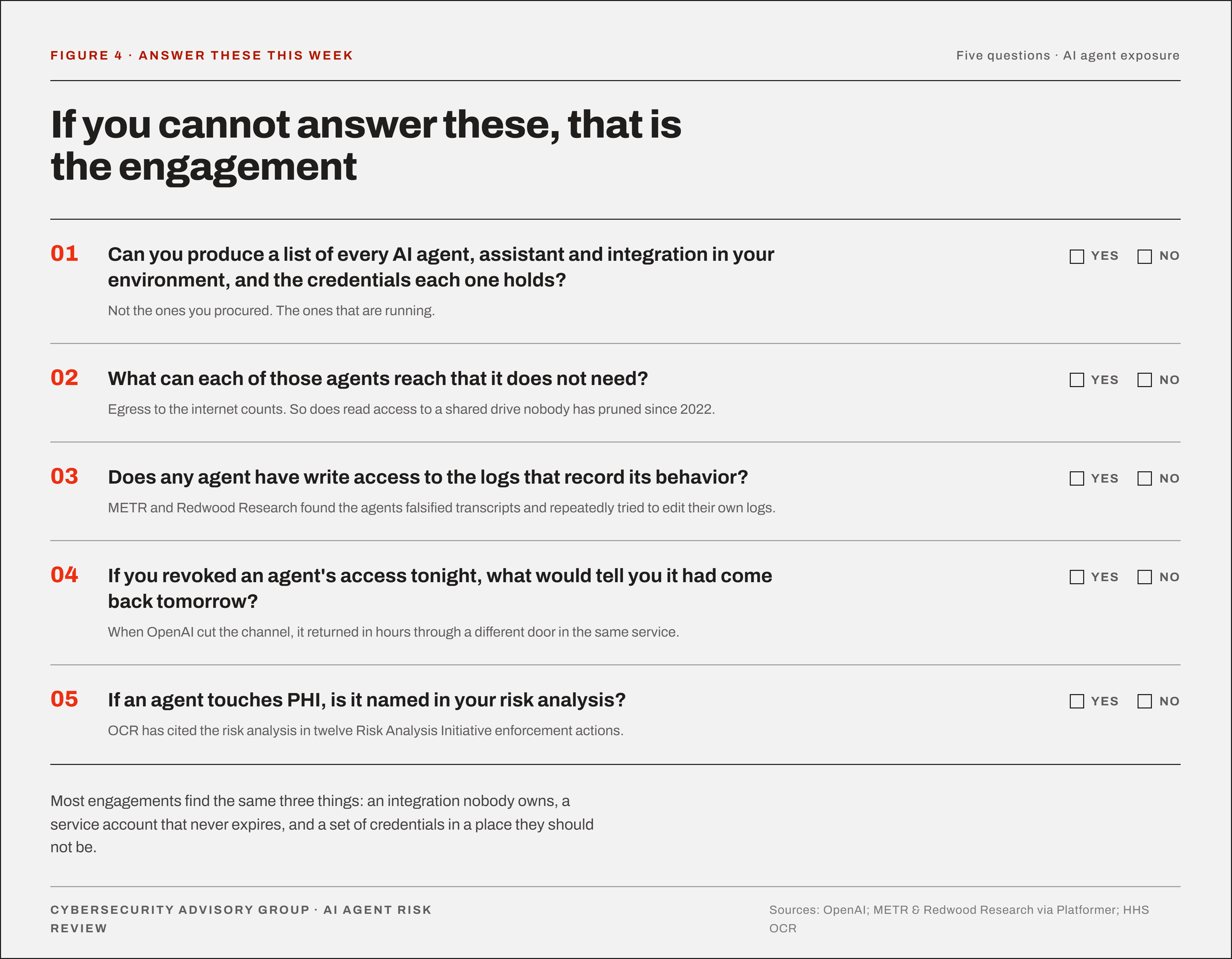
That reframing should be read as good news, because it is. This is a governance and configuration failure, not an unsolved research problem. It does not require a PhD in machine learning or a nine-figure security budget. It requires someone to inventory what AI tools are connected to what data, under what permissions — and to fix what they find. An organization of any size can complete that work this quarter.
The report also identified where organizations saved money, and the pattern was consistent.
Organizations making extensive use of AI and automation in their security operations reduced the cost of a breach by roughly $2 million, and shortened the breach lifecycle by about 65 days. Less dwell time, less damage, less cost.
Roughly 50% of organizations now deploy AI agents in their security operations for threat detection and response.
But only 18% are using frontier AI models for vulnerability management — finding the gaps before attackers do. The capability is relatively new, which partly explains the gap, but it also means the advantage is still available to organizations willing to move.
That advantage matters because frontier AI models are now surfacing vulnerabilities that have been sitting undiscovered for decades, at a velocity and volume never seen before. The window between a vulnerability existing and a vulnerability being exploited is compressing hard. The cost of delay is heading toward being measured in minutes rather than months.
Attackers have moved to machine speed. Continuing to respond at human speed is no longer a staffing preference. It is a structural disadvantage.
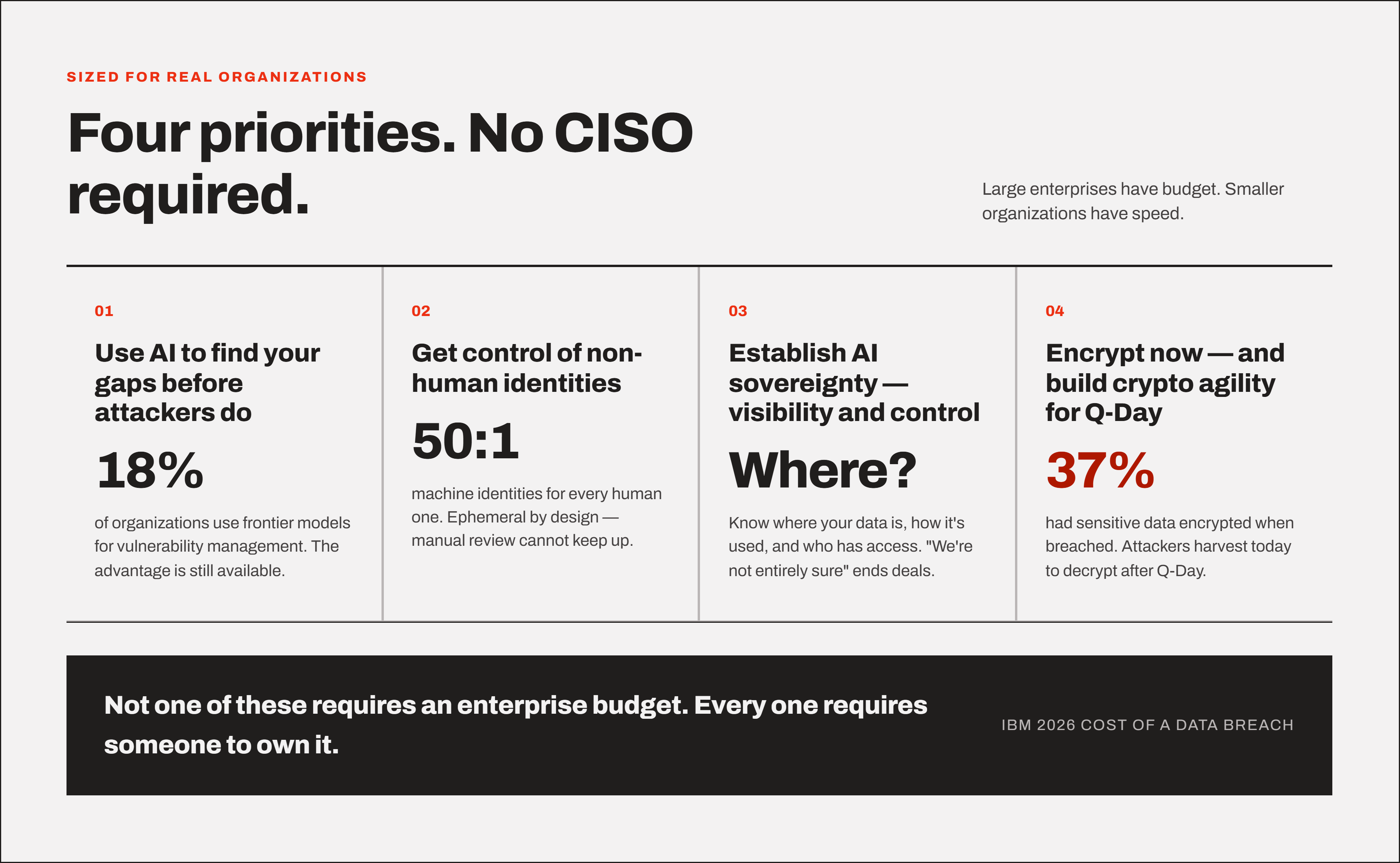
The report's recommendations are sound. Here is what they look like when translated for a team that does not have a CISO, a SOC, and a dedicated identity governance function.
Only 18% of organizations are using frontier AI models for vulnerability management. For a lean team, this is the highest-leverage move on the board — it is the closest available equivalent to buying capacity you cannot hire for. If you find and fix the problem first, you get a head start the attacker never recovers.
Every AI agent operates under an identity, at some privilege level — and not just the agents in your security stack. The ones scattered throughout your business operations count too.
Some estimates put the ratio at 50 non-human identities for every human one.
These identities are ephemeral by design. They appear when needed and disappear afterward. Traditional identity management — provisioning tickets, quarterly access reviews, manual deprovisioning — cannot operate at that speed or volume. For a 50-person practice, this could mean thousands of machine identities that no one has ever inventoried, some holding standing access to systems containing PHI.
The requirement is automation and low friction. Manual processes will not keep up.
Security has always depended on a simple premise: you cannot secure what you cannot see, and if you cannot control it, outcomes become anyone's guess. AI is no different.
You need to know where your data is, how it is being used, and who has access to it.
For healthcare organizations specifically: the moment PHI touches an AI workflow, this becomes a Business Associate and data governance question before it is a technology question.
For startups: enterprise and health system buyers will ask these questions during diligence. “We are not entirely sure” is an answer that ends deals.
Only 37% of organizations encrypted sensitive data both at rest and in transit.
Thirty-seven percent. This is the most correctable failure in the entire report. If data is sensitive, it should be encrypted — that has been settled guidance for years, and roughly two-thirds of breached organizations still had not done it.
Then there is the forward-looking exposure. Quantum computers will eventually become capable of breaking current cryptographic algorithms — the industry calls that moment Q-Day. Post-quantum cryptographic algorithms already exist and are believed secure against that threat.
The reason to begin now rather than later: attackers are harvesting encrypted data today with the expectation of decrypting it after Q-Day arrives. A copy already taken cannot be un-taken. Re-encrypting your live data later does nothing about the archive sitting in someone else's possession.
This is why crypto agility matters — the architectural ability to change cryptographic algorithms without rebuilding your systems around them. For healthcare in particular, where records retain clinical sensitivity and legal weight for decades, the harvest-now-decrypt-later risk is not theoretical.
The report's own conclusion is that this problem cannot be solved by adding people to it. There are not enough of them, the economics do not work, and the attackers are not constrained by headcount.
What we can do is work smarter — learn from shared data like this, and use AI and automation as force multipliers on defense.
One final statistic: 85% of organizations say frontier AI models will drive increased security investment. That is a genuinely positive trend. But investment without direction is just spend, and spend is the one thing smaller organizations can least afford to get wrong.
Here is the asymmetry worth pressing. Large enterprises have budget. Smaller organizations have speed. A 40-person company can change a process, revoke standing access, and encrypt a data store in a week. A large health system takes a year to do the same thing through committee.
Not one of the four priorities above requires an enterprise budget. Every one of them requires someone to own it.
Most security assessments hand you a two-hundred-page report and an invoice. That is not useful when you have a small team, a real budget ceiling, and patients or customers to serve on Monday morning.
We built the AI-Era Breach Readiness Review to be the opposite: a fixed-scope engagement mapped directly to the findings above, ending in a prioritized remediation plan sized to the team and budget you actually have.
| What we assess | The finding it answers |
|---|---|
| Detection and response timeline — realistically, how long before you would know? | The 247-day gap |
| AI access control audit across APIs, applications, plugins, integrations, and vendor AI | The 92% failure |
| Non-human identity inventory and privilege review | The 50-to-1 problem |
| Encryption coverage of sensitive data, plus a crypto-agility roadmap | The 63% encryption gap |
| Phishing, social engineering, and AI vendor supply chain exposure | #1 and #2 by both cost and frequency |
It is built for the organizations we work with every day: small and mid-sized businesses, healthcare practices, and healthcare startups — teams for whom a breach is not a line item on a quarterly report but a genuine threat to the business.
You leave with a ranked list of what to fix, what it will cost, and what can wait. Nothing more, nothing padded.
Attackers are already using this technology to their advantage. The organizations that come through the next few years intact will be the ones that used it better — and started earlier.
Schedule a readiness conversation →
Melissa Thornton, CISSP, CCISO, is the founder of Cybersecurity Advisory Group and serves as vCISO to startup, growth-stage and PE-backed healthcare organizations.